[Video no longer available]
LEGO DIGITAL BOX – augmented reality kiosk system
Excellent use of AR for marketing: an in-store display that’s actually fun to play with, and it makes you pick up the box in order to see it come alive. Nice.
(Via Make)

[Video no longer available]
LEGO DIGITAL BOX – augmented reality kiosk system
Excellent use of AR for marketing: an in-store display that’s actually fun to play with, and it makes you pick up the box in order to see it come alive. Nice.
(Via Make)
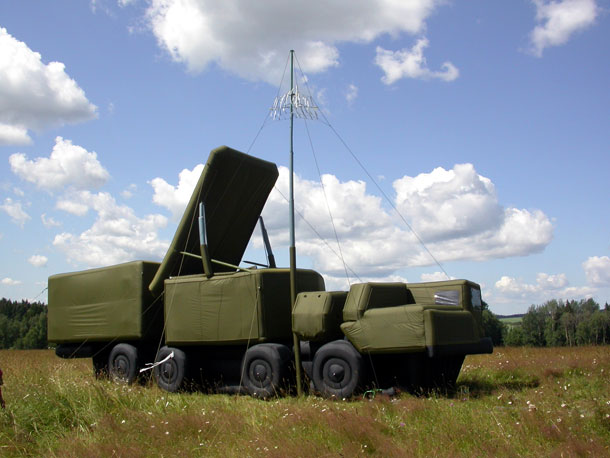
The Discover blog reports on a Potemkin army:
Russian balloon maker Rusbal is working on an order from the country’s defense ministry to supply full-scale inflatable military models. The realistic-looking hardware is used in battlefield positions and to protect Russian strategic installations from surveillance satellites, distracting snoops and protecting real combat units from strikes. They can look like real vehicles in the radar, thermal, and near infra-red bands, so they’d even look right through night-vision goggles.
And now from Shakespeare’s Macbeth (Act V Scene IV — you know, the cool part where the incoming army disguises itself as the Birnam forest):
MALCOLM
Let every soldier hew him down a bough
And bear’t before him: thereby shall we shadow
The numbers of our host and make discovery
Err in report of us.
Nothing much new, then. Simple visual misdirection is the magician’s greatest asset.
See also:
PowerPoint makes us stupid. It’s dangerous because it can create the illusion of understanding and the illusion of control. […] Some problems in the world are not bullet-izable. Gen. James N. Mattis of the Marine Corps, the Joint Forces commander, quoted in today’s New York Times article We Have Met the Enemy and He Is PowerPoint.
At no point has it even occurred to me, until right now, that I’m in fact typing e-words or e-sentences. I’ve not thought about adding an e-carriage return to separate this e-paragraph from the next e-paragraph. From Brett McLaughlin’s post on O’Reilly Radar asking why publishers and vendors are still using the term e-books when it’s simply literary content that’s appearing on a different platform. You could also argue that the term book itself is beginning to get slippery. In any case, “ebooks” has been sounding dated for a while now, so I’ll give him that.
A Turing Machine. Possibly the nicest assembly I’ve ever seen of 35mm film, servos, motors, and dry erase markers that’s actually capable of demonstrating the foundational theories of computing. A bit slow on the maths, but who’s complaining?
(Via Make)
Research video demonstrating an ability to automatically select individual elements of a recorded song (like the vocal track, guitar solo, ringing cellphone, etc) by singing, whistling, or even Beavis & Butthead style grunting in imitation. Not 100% perfect, but it’s very clever. (I wish the video was embeddable…)
Here’s a link to the original paper (PDF) presented to at the 2009 ACM User Interface Software and Technology symposium.

If you’re the sort of lab that’s engineering a method of printing ceramic materials using rapid prototyping machines, I suppose it’d make sense that you’d already have made some real-life polygonal Utah teapots! I never thought about it before, but for the 3D graphics humor value I really, really want one of these now. You can read about the Utanalog project and see finished photos (and a video explaining the whole thing) over on the Unfold blog.
Without answering, I handed the telephone to the applicant, and sat down. Then followed that queerest of all the queer things in this world,—a conversation with only one end to it. You hear questions asked; you don’t hear the answer. You hear invitations given; you hear no thanks in return. You have listening pauses of dead silence, followed by apparently irrelevant and unjustifiable exclamations of glad surprise, or sorrow, or dismay. You can’t make head or tail of the talk, because you never hear anything that the person at the other end of the wire says.
Mark Twain, writing an article for the June, 1880 issue of The Atlantic on the oddity of telephone conversations. Still relevant in our age of disjointed retweets, wall posts, and other overheard messages.
(Via Discover)
Google Wave was built to show younger people how older people feel when they try to use the Internet. (@shiflett, via Swiss Miss)
A circa-1966 industry ad for Leon Maurer’s Animascope process for producing animation on the cheap: animation without drawing and with fewer pesky artists! Similar to but different than rotoscoping, this process used high-contrast photography and actors in contrasty costumes with their skin painted white and contour lines painted on. The performers would then be filmed dancing around under bright light on a black-lined stage, and the resulting photography could be composited onto traditional background plates. Weird, but sort of a primitive version of mocap, and done for the same economical reasons.
(Via Cartoon Brew – for more info on the process, a good place to start might be this comment left by Brew reader Kustom Kool)