[Video no longer available]
Gold, an acrylic + light sculpture by Evan Roth of the Graffiti Research Lab, capturing the marker movement of Jean-Michel Basquiat’s handwriting. The way the projected light spirals through the acrylic is beautiful!

[Video no longer available]
Gold, an acrylic + light sculpture by Evan Roth of the Graffiti Research Lab, capturing the marker movement of Jean-Michel Basquiat’s handwriting. The way the projected light spirals through the acrylic is beautiful!
Eyewriter 2.0 + Robot Arm = Livewriter. Combining the FFFFAT Lab’s inspirational Eyewriter project (named this week as one of Time’s top 50 inventions of 2010, and now glasses-free!) with their GML RoboTagger Sharpie Magnum-wielding robot arm, kids were able to try out the eye-tracking graffiti system to print out giant-sized tags of their own names. These projects touch on so many of my favorite areas of interest, so very cool.
https://vimeo.com/14575301
A novel way to view Graffiti Markup Language tags: Obama GML Playa.
And speaking of the Graffiti Research Lab, if you happen to be in Houston next week, you can see the local chapter demonstrating their laser tagging as part of the MEDIA ARCHEOLOGY event at the Menil.
Digital Graffiti Wall + Stencils from Alex Beim on Vimeo.
Tangible Interaction’s Tangible Graffiti Wall. Rear projection drawing screens with IR “spraycan” interface. The cherry on top is the ability to use virtual stencils while painting – clever.
(Via Make)
GML (Graffiti Markup Language) drawings from 000000book.com are converted into DXF via a small Processing utility. Motion paths for a robot arm are developed from these DXF files using Rhino and MasterCam. The ABB IRB-4400 series arm is wielding a 2″ Montana Hardcore marker. Developed 11 January 2010 by Golan Levin and Jeremy Ficca in the CMU Digital Fabrication Laboratory (dFAB).
Concept: Evan Roth, F.A.T. Lab
Programming & Production: Golan Levin
Machining & Motion Planning: Jeremy Ficca
Co-produced by the CMU STUDIO for Creative Inquiry and the CMU Digital Fabrication Laboratory, in cooperation with FAT Lab and 000000book.com. For more information please see http://www.flong.com/blog/archives/565.
The GML RoboTagger. Automated calligraphy via the Graffiti Markup Language and an industrial robot arm gripping a giant Sharpie or Montana Hardcore magic marker. Tele-tag.
There’s a bit more about the project on Golan Levin’s blog.
(Via fffff.at)
GML = Graffiti Markup Language from Evan Roth on Vimeo.
The FAT LAB crew put the markup back in markup language, with their week dedicated to creating new applications and standardizing their existing work around a Graffiti Markup Language, an XML archive format describing tagging and gestural drawing. Rad.
See also: the new DustTag and Fat Tag Deluxe iPhone apps.
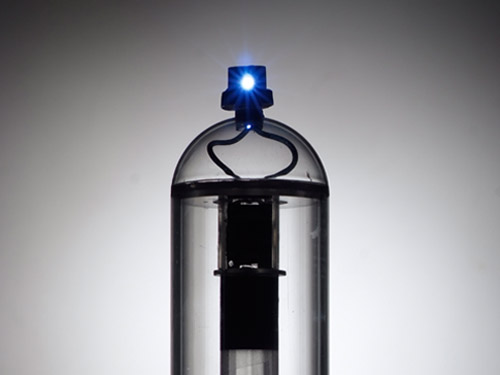
I hate to steal links from the Make blog multiple times in a single day, but this is another one that’s hard to pass up. French product/industrial designer Aïssa Logerot created an LED-tipped fake spray can for doing a bit of light (photo) graffiti. Even better, the battery can be recharged by shaking the can. Genius.
(Via)
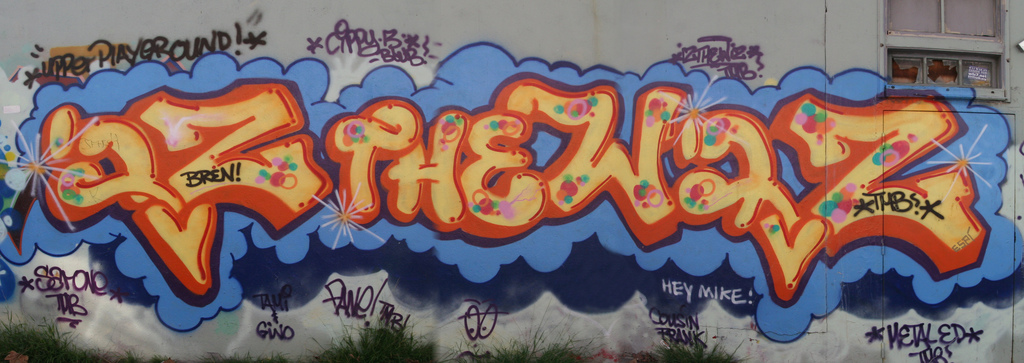
Michael Martin, Subway Graffiti Artist Iz the Wiz, Is Dead at 50
“Look at any movie shot on location in New York from the late 1970s to the early 1980s, and you will very likely see an Iz tag,” Mr. Walker said. “He told me once that in 1982 he went out every night and did at least a hundred throw-ups” — letters filled in quickly with a thin layer of color. “People can’t fathom it.”
(Photo by AlexRan)